
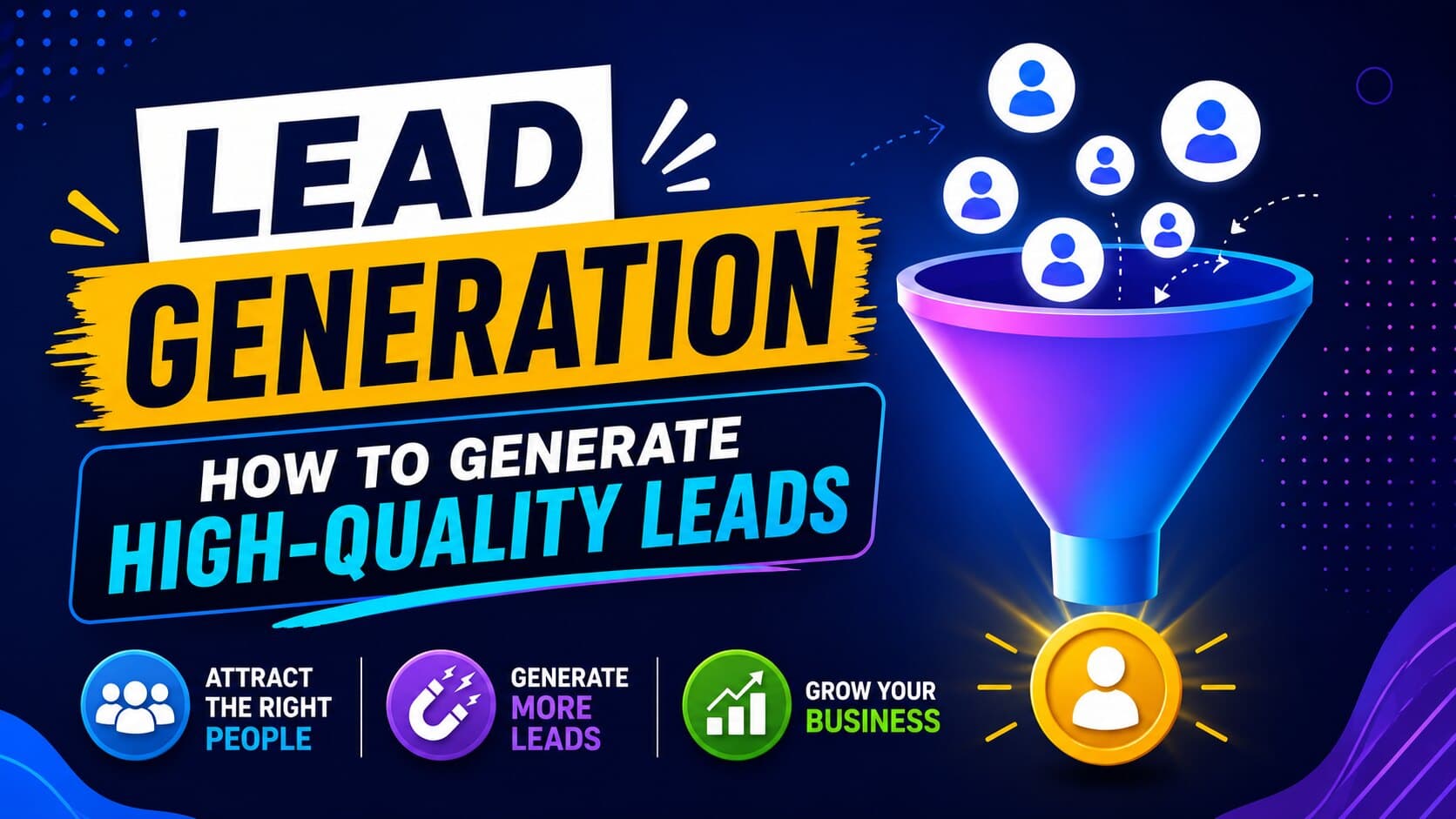
Lead generation is a marketing method that entails drawing people towards your business in a way that creates a relationship between you and your potential clients either by filling out a form, making a phone call or downloading something. This involves creating a value proposition and providing visitors with some means through which they can connect with your company once they get intrigued enough to take an action. In other words, a lead generation campaign entails bringing people from "just surfing" to "wanting to learn more". This task is achieved through such marketing methods as SEO, social media, email marketing and paid advertising. Once traffic is generated, it is captured with the help of landing pages and CRM platforms. A good program filters all visitors and only works with those who are likely to purchase the product or service offered. When done properly, this technique allows marketers to turn marketing efforts into a systematic process that provides a return on investment on each dollar invested.
What Is Lead Generation?
Lead generation implies the interest of a total stranger in your products to the point of revealing some basic personal information – a name, email, or phone number. This simple transaction is the beginning of a relationship between you. When the potential client starts sharing his/her contact information, he/she becomes a lead whom sales or marketing team can further reach.
Why Lead Generation Matters for Every Business
No business can survive purely due to the repeat business of its current customers. New leads ensure the continuous inflow of leads into the sales pipeline, as well as guarantee safety in terms of bad periods or loss of customers. Without regular influx of new contacts, no matter how successful the product may be, it will lack buyers sooner or later.
How Lead Generation Supports Business Growth
The efficient lead generation machine provides the sales department with customers who already have some level of familiarity with the brand, thus reducing the average selling period and the cost of the conversion. Lead generation process also provides marketing department with the data about the efficient messages to send, thus improving campaigns.
How the Lead Generation Process Works
Identifying Your Target Audience
The process starts with finding out who you need to connect with. This requires creating a picture of your perfect client and identifying his occupation, budget and pain points. If the step is omitted, you will just throw money away on ineffective advertising and marketing, as you won’t address any specific audience.
Attracting Potential Leads
After finding out who you need to reach, comes the next step – attracting them to you. In order to do that, blog posts, social media posts, pay-per-click ads and referrals will help you get in touch with your target audience. At this point, you are looking for visitors who correspond to the audience found in step 1.
Capturing and Qualifying Leads
People need an incentive to give you their contact information. For this purpose, a landing page with an effective offer and a short form work perfectly. Further, qualification helps distinguish those who are really interested in what you can offer from those who got here by accident.
Nurturing Leads into Customers
The majority of leads are not ready to become customers right after registration; nurturing allows maintaining communication through emails, retargeted advertisements, and valuable content until they are ready to communicate with the sales team. Not taking this step is the main reason why potential clients get cold, as the lack of fast response makes them move to competitors.
Types of Lead Generation
B2B Lead Generation
Speaking of lead generation in business-to-business context, the target audience consists of companies rather than customers; sales process takes more time because of a participation of a number of people in decision making process. In such a case case studies, webinars and LinkedIn activities can be successful techniques.
B2C Lead Generation
In the business-to-consumer context, individuals are targeted; the lead generation process is typically faster because an individual can make the purchasing decision. Social media ads, email marketing and influencer marketing are typical techniques used in this area.
Inbound Lead Generation
This term refers to situations when leads come to you owing to appealing content, good SEO or recommendation of other people. This type of lead generation is more cost-effective but needs some patience as it takes some time to create marketing content and boost SEO positions.
Outbound Lead Generation
However, in the case of outbound marketing, you will need to start communication with the customer through cold emails, cold calls, or even paid ads. Even though it can be more time efficient, it is more costly and difficult to be aimed at the right people.
Top Lead Generation Strategies
The best strategies for lead generation are never concentrated only on one source. Here are some sources that most businesses use:
- Search Engine Optimization (SEO): By dominating your potential clients' search engine results page, you can get steady and inexpensive traffic.
- Content Marketing: Through all your blog posts, guides, and videos, you can earn the prospect's trust before he/she communicates with the sales person and convince him/her why you are the best option.
- Social Media Marketing: Using social networks such as LinkedIn, Instagram, or Facebook, you can remain in touch with the customer and build a community of trusted brand.
- Email Marketing: A very profitable technique of contacting those customers who have already showed interest in your offer.
- Pay-Per-Click (PPC) Advertising: This type of advertising allows placing your message in front of the target audience immediately, which does not require any organic activity on your part, which is beneficial for a quick result.
- Referral Marketing:Satisfied clients can be an excellent source of potential new leads when there are easy referral options available to them.
Proven Lead Generation Techniques
It is good to have a strategy in place, but the following list of techniques will ensure that it works properly:
- Create High-Converting Landing Pages: Single focused landing page with a single offer and single call to action beats the competition all the way, because each additional link is a reason to close the page.
- Offer Valuable Lead Magnets:People like to get freebies and guides related to some specific topic that helps them to solve the existing issue.
- Optimize Calls-to-Action (CTAs): It can be surprising, but even small change of wording, colors or CTA placement can bring a noticeable increase in click-through rate.
- Use Marketing Automation: Automated emails and lead scoring are very useful and convenient techniques that allow saving time for marketing personnel.
- Personalize Customer Communication: Messages that mention one’s field, job title, or previous behavior will be more effective since they won’t seem like spam and will get a higher level of engagement due to the principle of relevance.
Best Lead Generation Tools
Proper tools help generate leads efficiently and effectively:
- CRM and Lead Management Tools: Such platforms as HubSpot or Salesforce organize all leads and help to monitor where each of them is in the buying process and what stage the dialogue with the potential client is now.
- Google Ads for Lead Generation: These ads appear when a user is actively searching for something and hence, their intention level is extremely high, resulting in quick conversion.
- Meta Ads Manager for Lead Generation: This option is useful for targeting leads according to their interests and behaviors and therefore may be applied not only for generating leads but also for increasing brand awareness.
- LinkedIn Sales Navigator: A tool used by B2B teams for finding the right contacts and contacting them directly.
- Email Marketing and Automation Tools: Platforms like Mailchimp and ActiveCampaign automate lead nurturing process without having to personally follow up with all prospects, thus giving space for interactions where human intervention is needed.
How to Build a Successful Lead Generation Campaign
Define Campaign Goals
First of all, before spending money, you need to figure out what your goal is. Do you need a certain number of leads? What is the cost per lead? Or how much revenue do you plan to get? Setting campaign goals will help everyone know what the final result should look like and how you will be able to measure success.
Create an Effective Offer
The offer is something that will make a person willing to share his contact information. Your offer should solve the problem of the user or answer his questions; it can be an appointment, a discount or just some useful content that is not easy to find elsewhere.
Choose the Right Marketing Channels
Different marketing channels work well for different target audiences. While LinkedIn and emails are the right choice for B2B campaigns, Instagram and paid search advertisements are perfect for consumer-based brands.
Launch, Monitor, and Optimize
As soon as you launch your marketing campaign, you should definitely not forget about monitoring it, at least in the first few weeks. Things like poorly performing ads, low-quality subject lines, and even a confusing landing page will be easier to fix straight away than when the marketing campaign comes to an end.
Lead Generation Examples Across Industries
SaaS Companies
Many software firms rely on their free trials and demo offers in order to generate leads. The reason why such a strategy is effective is due to the absence of risk on behalf of the customer since he/she gets to test the product prior to purchase.
E-commerce Businesses
Email discounts, abandoned cart reminders, and retargeted advertising are commonly used by online stores in order to lure consumers back into making purchases.
Healthcare Providers
Informational content, appointment booking forms, and local SEO are all popular lead generation techniques used by clinics and healthcare providers because trust is important in this sector. Patient reviews and easily accessible contact information are what separate clicks from scheduled appointments.
Real Estate Agencies
Property listings, virtual tours, and local landing pages are typical lead generation strategies used by real estate agencies. Follow-up calls, open house sign-ins, and neighborhood guides are popular methods for capturing the contact information of serious buyers and sellers.
Professional Service Businesses
Accounting firms, lawyers, and consultants use case studies, consultations, and content related to their specialization for generating leads. Trust and long-term relationships are usually associated with such purchases; thus, referrals and reputation play an important role here.
Lead Generation Best Practices
- Focus on Lead Quality Over Quantity: It is always better to have fewer but more qualified leads than a long list of bad leads who take salespeople’s time but never purchase anything.
- Optimize Your Website for Conversions: Website speed, easy navigation, and optimized forms are important factors that reduce friction between customer's interest and action.
- Align Sales and Marketing Teams: In case both teams reach an agreement regarding how to qualify a good lead, poor quality leads are left behind while the movement between both departments becomes easier.
- Test and Improve Campaign Performance: By consistently performing A/B testing on headline, offer, and CTA, we can make sure that campaign performance improves each time instead of getting stuck somewhere because what worked today may not work tomorrow.
- Track Key Performance Metrics: There’s nothing you can improve if you don’t monitor it, therefore constant tracking must be incorporated in any successful campaign.
How to Measure Lead Generation Success
Conversion Rate
Conversion rate shows what percent of people visit your site take action that you want from them - complete a form or book an appointment, for instance, and conversion rate can be determined relatively quickly.
Cost Per Lead (CPL)
CPL allows you to see how much you’re spending on each lead which will enable you to see the efficiency of various channels.
Customer Acquisition Cost (CAC)
CAC takes the efficiency measurement process a little bit further since it calculates how much it costs to convert a lead into a paying client including sales efforts and software costs.
Return on Investment (ROI)
It indicates whether the money made from the leads is higher than the money you invested in obtaining those leads.
Lead-to-Customer Conversion Rate
It calculates how many leads have turned out to be actual customers; it will indicate whether there is any issue with the quality of the leads or the sales process.
Future Trends in Lead Generation
AI-Powered Lead Generation
With the help of artificial intelligence software, one can score leads more quickly, personalize interactions with each lead, and predict which prospects will convert.
Predictive Analytics
Using data collected from previous customers' behavior, one can determine which leads share similar characteristics with those buyers.
Conversational Marketing
Chatbots or live chat tools allow one to capture leads instantaneously, without making them wait for an email response.
First-Party Data Strategies
Losing third-party cookies, businesses will need to depend on data about themselves and user interaction with the website even more than before.
Interactive Content
Tests, quizzes, and calculators are becoming more popular as lead magnets because users receive something personal in exchange for the information provided.
Conclusion
Getting leads is not just a one method approach; it is an ongoing process that requires right targeting, right offer, and follow-up. Companies that treat getting leads as an event rather than a process will soon find out that they cannot sustain their lead generation efforts. However, the businesses that keep testing things and measure performance will create a pipeline that can be sustained. Firstly, you should determine who your target audience is, select 2-3 channels where your prospects are present and start measuring everything regularly. Over time, it will make a huge difference for the companies that have a constant supply of leads and those that are desperate waiting for the next sale. There is no magic solution but the companies that persistently do their job and measure results will achieve success.
FAQ’s
1.What is lead generation in simple terms?
The concept of lead generation can be easily explained as attracting people who want to buy your products and collecting their contact details, for instance, their email address or telephone number. It starts with an offer of an incentive, for example, a free guide or discount, which is made to the right audience through the channels of promotion like social media, search engines, and others. After this, further communication may occur, which can be associated with efforts to convert this person into a customer sooner or later.
2.What is the difference between B2B and B2C lead generation?
The key difference consists in the following: B2B lead generation is directed towards other business entities, which usually include many stakeholders and the long purchasing cycle. Thus, the most effective techniques of B2B lead generation include, for instance, outreach through LinkedIn or case studies. As for B2C lead generation, it focuses on consumers who make decisions individually.
3.How much does lead generation cost?
There are large differences between costs depending on which industry the company operates in and whether the leads come from paid or organic sources. Paid advertising through ads in Google or Meta might range anywhere from several dollars to well above a hundred dollars per lead depending on the competitiveness of the market, whereas organic techniques like SEO and content marketing will be cheaper per lead in the long run, although it takes a lot of time to gain traction.
4.What is a good conversion rate for lead generation?
Conversion rates depend greatly on both the industry and channel, but most landing pages will have a conversion rate ranging anywhere from two to five percent, with very high-performing ones at around ten percent or even higher. Campaigns that are very highly targeted and offer something special tend to convert better than generalized campaigns. Comparing your past statistics is much more useful than comparing with some kind of industry average.
5.What tools do I need to start generating leads?
At least, a CRM, a landing page builder, and an email marketing platform should be considered. Once you move on with your project, advertising platforms like Google Ads, or Meta Ads Manager, and analytics tools will allow knowing which channels bring real leads. Start with a little effort and use the basic tools until the needs appear and budget allows for something more.
6.How long does it take to see results from lead generation?
With paid channels, it is quite fast as it takes several days to start bringing leads because ads are launched almost right away. With organic methods such as SEO and content marketing, it takes three to six months to see traffic and leads because of the time needed for search engines to trust the content. The best strategy is to run paid and organic campaigns at the same time so that the pipeline won't get empty because of slower methods.